
Inclusive language matters
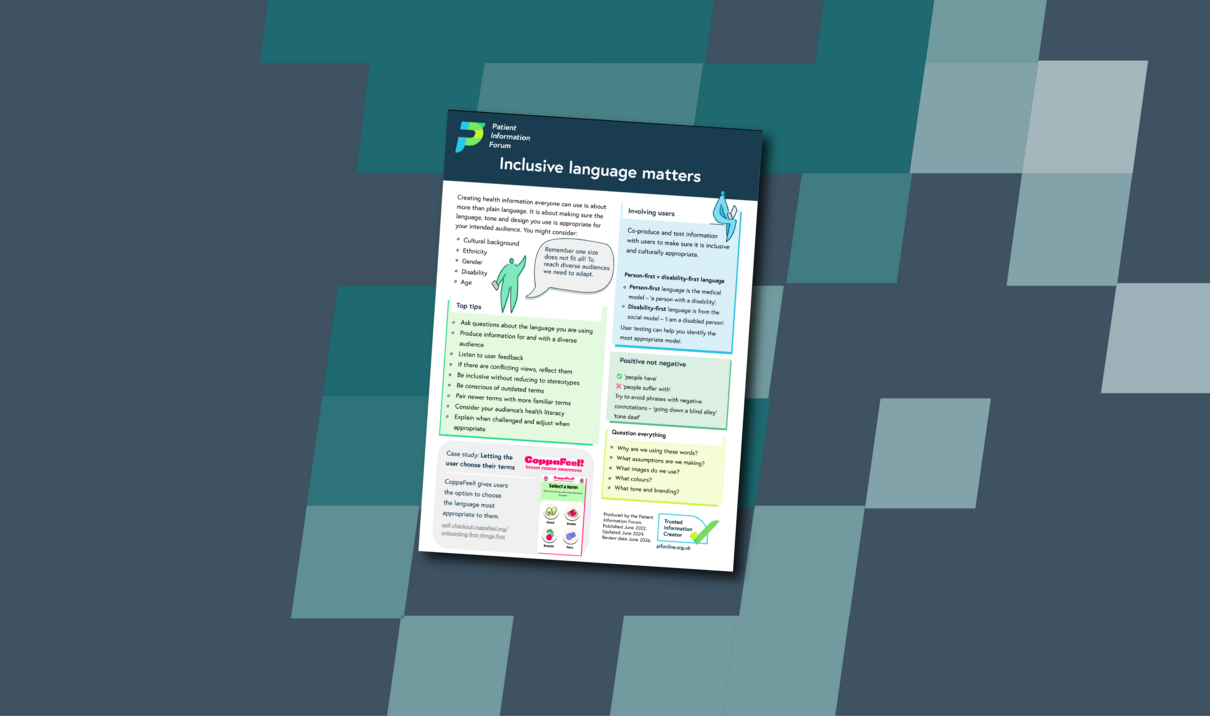
Creating health information everyone can use is about more than plain language. It is about making sure the language, tone and design you use is appropriate for your intended audience. You might consider:
- Cultural background
- Ethnicity
- Gender
- Disability
- Age
- Medical condition
Remember one size does not fit all! To reach diverse audiences we need to adapt to different needs and preferences.
Involving users
Co-produce and test information with users to make sure it is inclusive and culturally appropriate.
Person-first versus disability-first language
- Person-first language is the medical model – "a person with a disability".
- Disability-first language is from the social model – "I am a disabled person".
User testing can help you identify the most appropriate model.
Neutral not negative
✅ "people have"
❌ "people suffer with"
Avoid phrases which could be offensive – "going down a blind alley" "tone deaf".
Question Everything
- Why are we using these words?
- What assumptions are we making?
- What images do we use?
- What colours?
- What tone and branding?
Top tips
- Ask questions about the language you are using.
- Produce information for a diverse audience.
- Listen to user feedback.
- If there are conflicting views, reflect them.
- Be inclusive without reducing to stereotypes.
- Be conscious of outdated terms.
- Pair newer terms with more familiar terms.
- Consider your audience's health literacy.
- Explain when challenged and adjust as needed.
Case study: Letting the user choose their terms
CoppaFeel! gives users the option to choose the language most appropriate to them. View the self checkout tool here.
References
service-manual.nhs.uk/content/inclusive-content
Produced by the Patient Information Forum.
Published June 2022. Updated June 2026. Review date June 2028.
Inclusive language matters
Inclusive language matters
